


Benefits Realization in Practice: Preventing Value Erosion Across the Transformation Lifecycle
How organizations protect value from business case through delivery and realization
Building the Foundation for Value
Transformation initiatives typically start with the best of intentions.
Organizations develop well-modeled business cases, define clear strategic objectives, and assemble experienced delivery teams. Financial projections demonstrate strong returns and justify the investment in capital and resources.
At this stage, everything points toward success.
However, the way benefits are modeled during business case development can introduce risk early in the lifecycle. Enthusiasm for change and the pressure to secure funding can lead to optimistic assumptions about the value a program will generate. Strategic ambitions are translated into financial projections that reflect economic potential, but may not yet reflect the operational reality required to deliver that value.
Once execution begins, delivery pressures start to emerge. Timelines move. Costs shift. Scope evolves as teams respond to constraints and new information.
Then, toward the end of the program, when teams are fatigued and deadlines loom, the focus often shifts to simply completing delivery rather than protecting the final value outcome.
Across this lifecycle, value erosion can occur gradually.
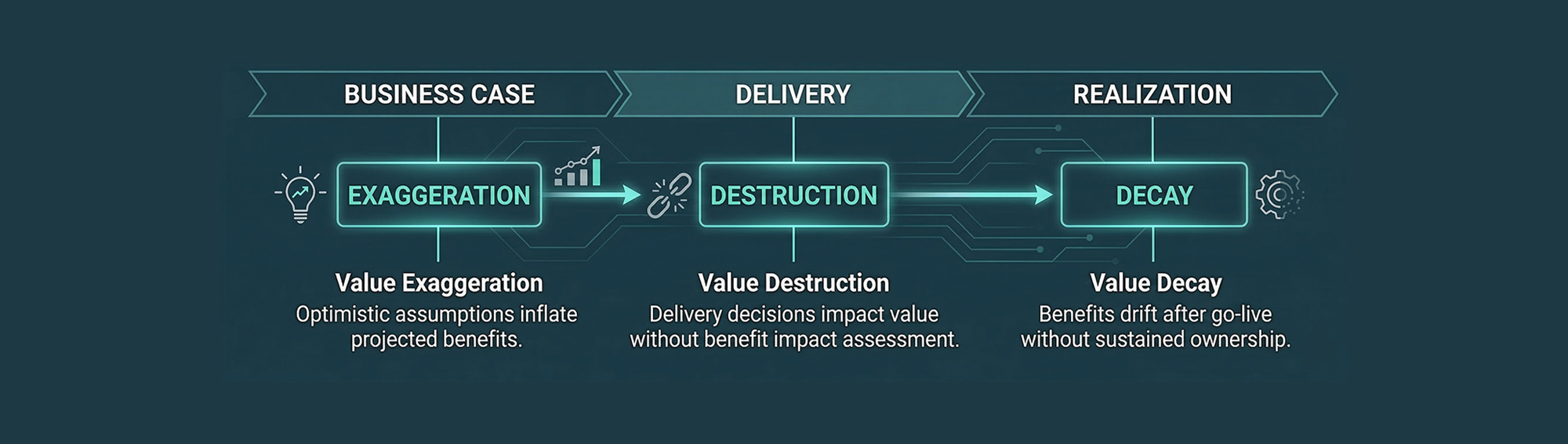
In practice, it typically follows three stages: exaggeration, destruction, and decay.
Preventing these stages requires more than financial reporting. It requires a system that actively governs value from planning through realization.
Stage One: Preventing Value Exaggeration
Value exaggeration occurs during business case development when projected benefits become inflated by optimistic assumptions.
Common indicators include:
- Benefits reverse-engineered to justify estimated program cost
- Strategic objectives translated into financial projections without operational baselines
- Double-counted or overlapping benefits across initiatives
- Key assumptions not explicitly documented or linked to measurable value drivers
Once capital is approved, these assumptions are often captured in spreadsheets or slide decks that sit outside the systems used to manage delivery.
As a result, they are rarely revisited or validated as execution progresses.
What mature organizations do differently
- Link benefits to clearly defined organizational value drivers
- Establish agreed baselines before capital approval
- Capture benefit assumptions explicitly and make them visible
- Connect projected benefits directly to initiatives within the execution environment
Outcome-Driven Discipline begins at capital approval — not at delivery.
Stage Two: Preventing Value Destruction During Delivery
Once delivery begins, governance attention often shifts toward maintaining schedule and budget performance.
Scope changes are evaluated based on cost impact. Timeline adjustments are assessed in nominal terms. Steering committees focus on milestone completion.
What is often missing is a structured assessment of the impact these decisions have on value realization.
Common indicators of value destruction include:
- Scope reductions approved without recalculating benefit impact
- Delivery delays accepted without modeling time-to-benefit consequences
- Decisions made without visibility into the broader economic implications across the portfolio
Without integrated financial and delivery data, organizations cannot evaluate the economic consequences of execution decisions in real time.
What mature organizations do differently
- Embed benefit impact assessment within change governance
- Maintain real-time visibility into benefit forecasts
- Link delivery performance directly to value trajectory
- Provide executives with portfolio-level visibility into economic outcomes
Data-Informed Decision Making must operate within delivery workflows — not after them.
Stage Three: Preventing Value Decay After Go-Live
Even when a program is delivered on time and on budget, value is not automatically realized.
Following go-live, delivery teams transition out. Finance may continue tracking forecasts and variances, often in isolation. Operational leaders inherit benefit accountability without structured governance support.
This is where value decay can begin.
Common indicators include:
- Adoption rates falling below forecast with no recalibration of expected benefits
- Original business case assumptions never revisited
- Benefits tracked outside enterprise execution systems
- No structured escalation or intervention when performance deviates
Benefits realization often becomes a passive monitoring exercise rather than an active management discipline.
What mature organizations do differently
- Transition benefit ownership formally into operational governance
- Maintain dynamic benefit forecasts beyond go-live
- Integrate benefit variance reviews into enterprise performance forums
- Enable early intervention when value signals deviate
Benefits realization continues well beyond program delivery.
Why Spreadsheets and Disconnected Systems Struggle to Protect Value
Many organizations attempt to manage benefits using spreadsheets layered alongside project management tools and financial systems.
This creates structural fragmentation:
- Delivery performance lives in one system
- Financial forecasts live in another
- Governance decisions rely on manually consolidated reporting
The consequences are predictable:
- Assumptions cannot be dynamically updated
- Scope changes cannot be economically modeled
- Executive visibility requires significant manual effort
- Early signals of value erosion are often missed
Spreadsheets may work for small initiatives, but they do not scale to enterprise transformation portfolios.
Benefits discipline requires integrated systems that connect strategy, delivery, and financial outcomes.
Embedding Benefits Governance into the Execution Layer
Amplify connects strategy, initiatives, governance, and financial outcomes within a single execution environment.
This enables organizations to:
- Link every initiative to measurable financial and non-financial value drivers
- Maintain visible baselines and dynamic benefit forecasts
- Model the impact of scope, timing, and investment changes before decisions are made
- Detect early signals of value erosion
- Provide executives with real-time portfolio-level value visibility
Benefits realization moves from retrospective reporting to proactive intervention.
Delivery decisions are evaluated not only on cost and schedule — but on economic consequence.
From Reporting Value to Engineering Value
Preventing exaggeration, destruction, and decay requires disciplined governance and connected systems.
Outcome-Driven Discipline ensures value assumptions are explicit and governed.
Data-Informed Decision Making ensures execution decisions are economically grounded.
When benefits are embedded within the execution layer, organizations move from directional ambition to engineered value realization.
Value does not disappear.
It erodes when it is not actively managed.
Stop managing benefits in spreadsheets.
See how Amplify embeds benefits governance directly into your execution layer — enabling early intervention and economically grounded transformation decisions.

